How KidCode grew, and what I do
KidCode is a Python program for children in Frisco, Texas. I wrote the curriculum and teach the classes.
Three years
2024. The first class was on June 5, 2024. The program ran in four neighborhoods, and students worked through the Year 1 curriculum: Python from zero.
2025. Year 2 began on June 5, 2025. The program reached seven neighborhoods. The curriculum moved on to tests, files, JSON, errors, classes and inheritance.
2026. Year 3 is natural-language processing with spaCy. The program now spans ten neighborhoods in all. That summer I also ran an online bootcamp for a new group of families, starting with a meeting at a neighborhood pavilion on June 27 and a first online session on June 28. Sessions on Google Meet and Zoom followed on July 5, July 11 and July 18; when few students could join, I rescheduled or canceled the class. From July 23 I added weekly quizzes, small projects and a points leaderboard with gift-card prizes.
In all, that is 124 students, and more than 1,200 programming projects completed: 138 in 2024, 504 in 2025 and 572 in 2026.
My role
- I started KidCode and wrote all three curricula.
- I write the lessons and slides, and I teach the classes.
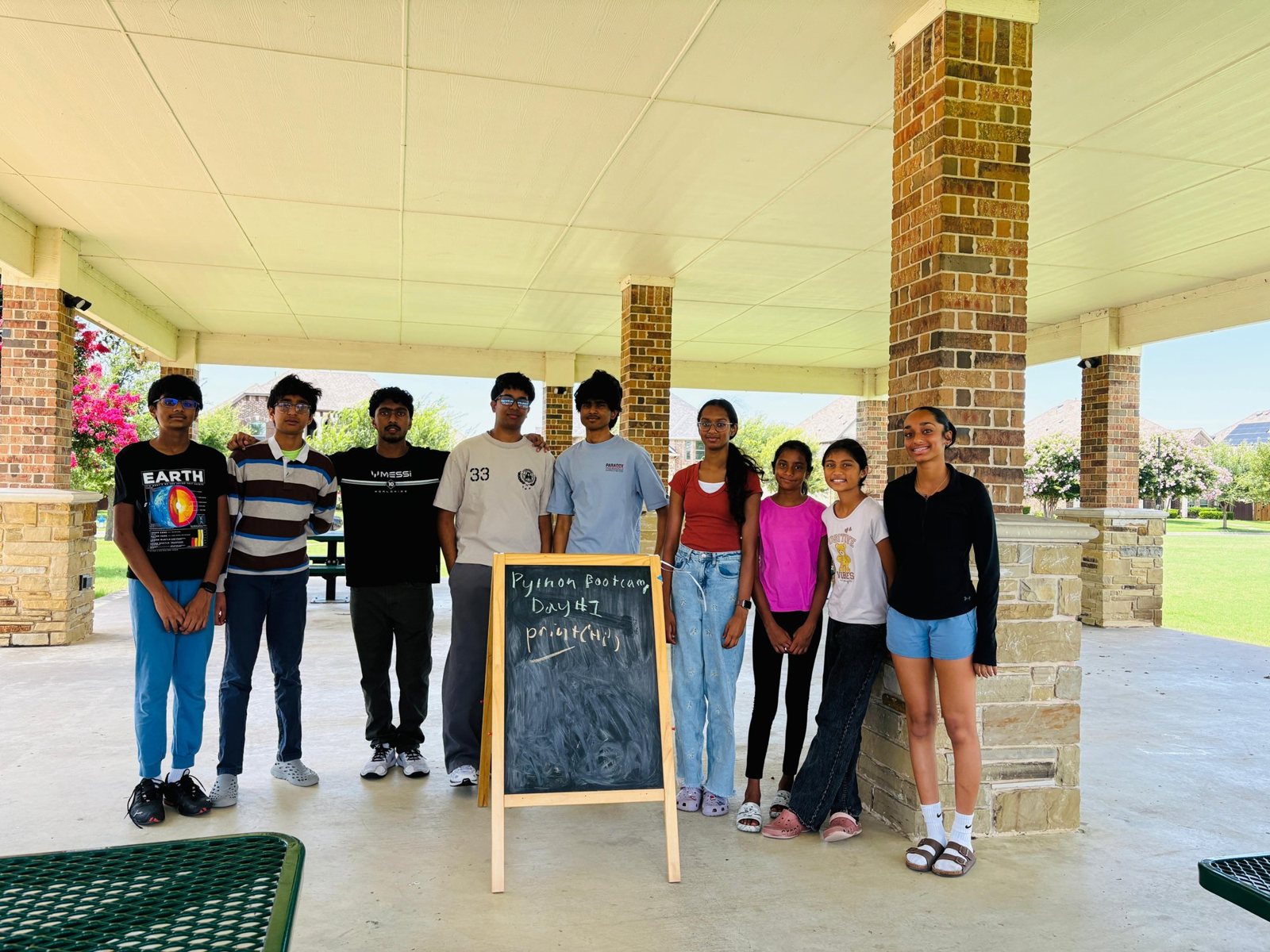
- As the program grew, I recruited peers who helped me teach classes, organize sessions and expand the program across the community.
- I organize the program: schedules, meeting links, and messages to families, including a recap and homework after each class.
- I wrote the 13 pairs of pre/post assessments and analyzed the results.
- In the summer 2026 bootcamp, two of them helped teach alongside me, and I ran the weekly quizzes and the leaderboard.
Where students live
KidCode's students live in ten neighborhoods of Frisco, Texas.
- 2024: Avondale, The Heights at Westridge, The Reserve at Westridge, Ridgeview at Panther Creek
- 2025: Prairie View, Miramonte, Dominion at Panther Creek
- 2026: Villages at Willow Bay, Frisco Heights, Panther Creek Estates
The classes
Each summer ran for eight weeks, with five one-hour classes per week: 40 one-hour classes per summer and 120 across three summers. Classes cover a new idea each day and end each unit in a project. You can see every day in the curriculum, and every project on its own page in the 20 projects.
Privacy
Students' names, contact details and other personal information are never published on this site. Photographs show people with names covered, and student work is shown without names.