X-Step: a plantar-pressure insole and app
X-Step is a student team's four-sensor insole for people at risk of diabetic foot problems. It streams foot pressure over Bluetooth to a phone app that shows live loading, trends and alerts.
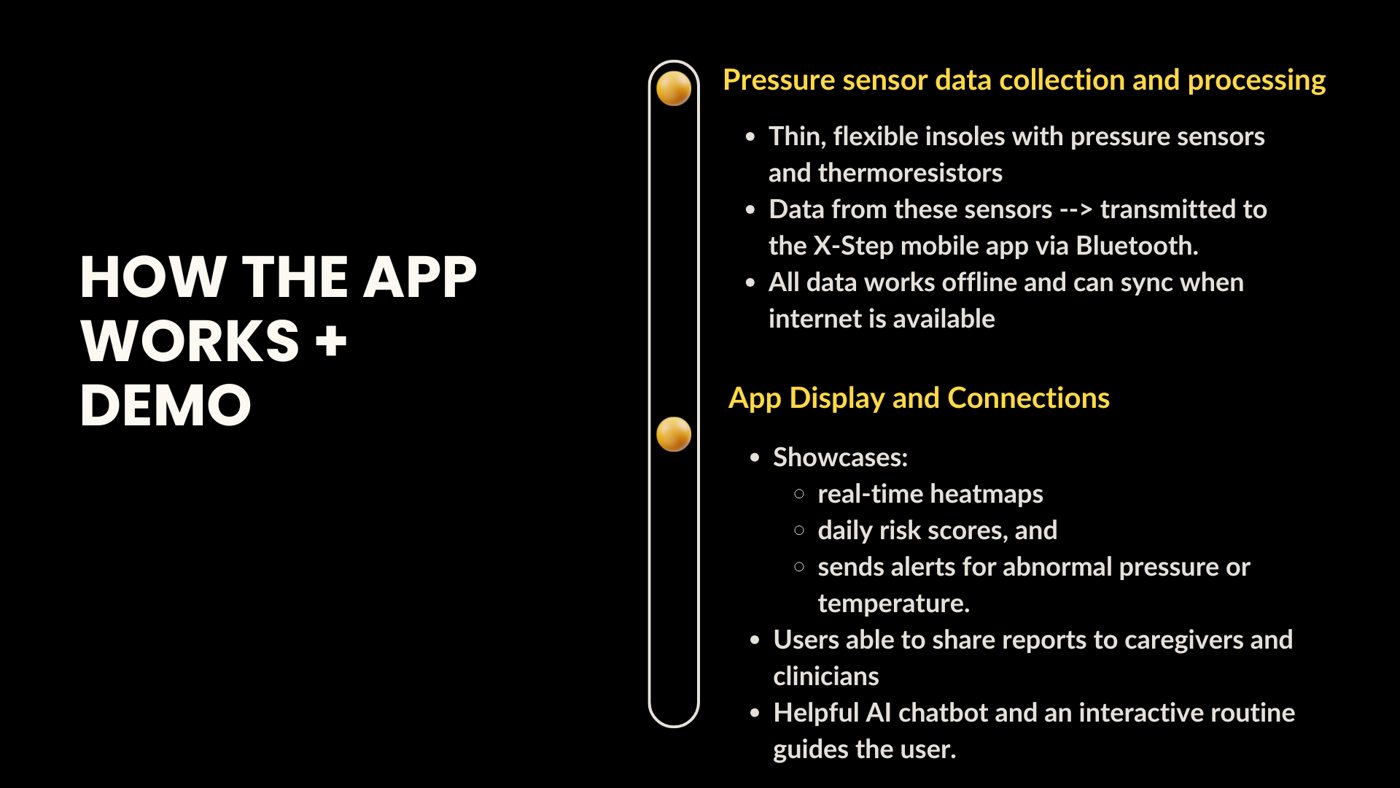
System, end to end
- Insole (team hardware). Four FSR402 force sensors under the first, second and fifth metatarsal heads and the heel, one board per foot.
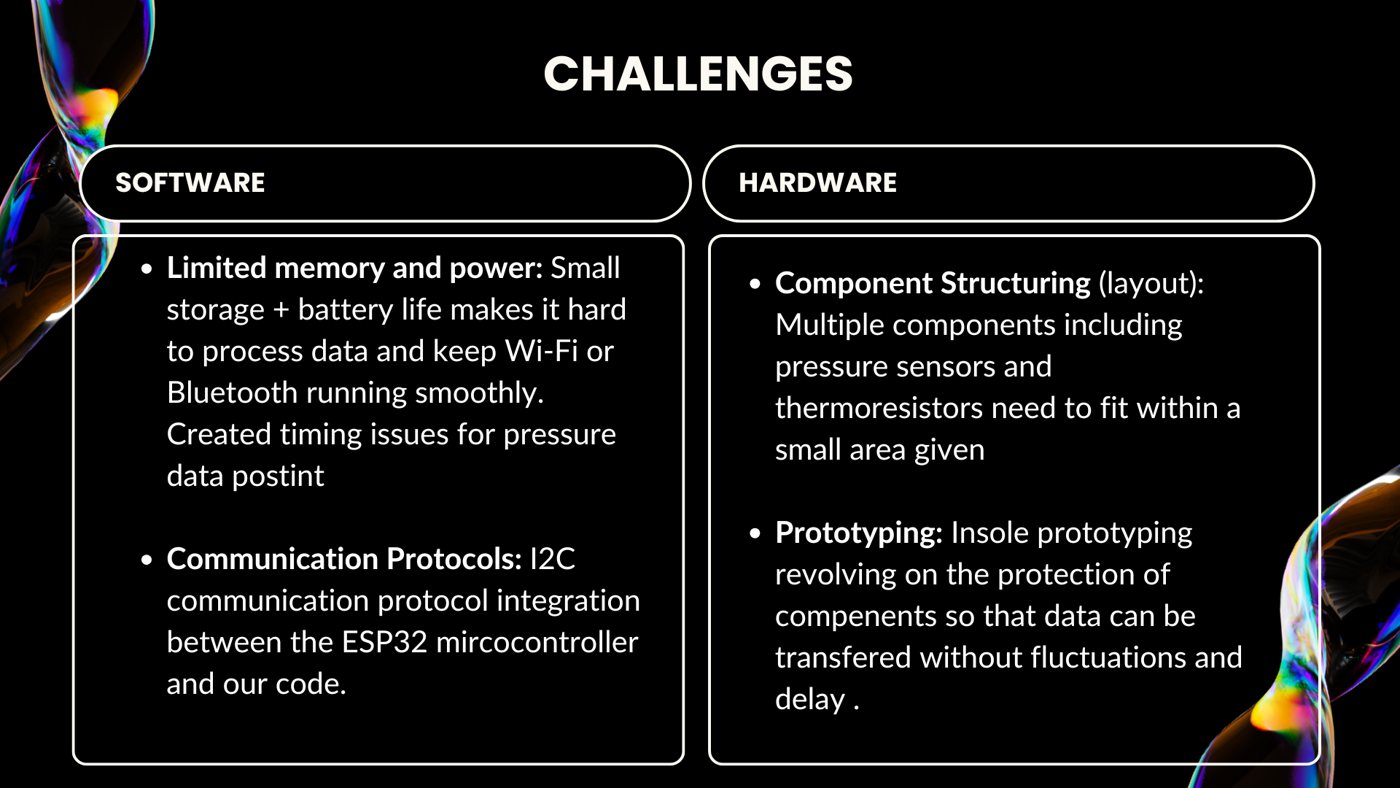
- Firmware (team). An ESP32 samples each sensor at 25 Hz and advertises as
XSTEP-LorXSTEP-R. - Link (team). A 28-byte Bluetooth Low Energy frame carries four ADC readings, a timestamp and a sequence counter, so dropped packets are detected rather than hidden.
- Features and model. On the host side, rolling 4-second windows are turned into 59 pressure and gait features and scored by a logistic-regression model.
- App (mine). A React Native (Expo) app pairs with both insoles and shows live pressure, cadence, trends and alerts, with a separate clinician view.
ML pipeline
My main technical contribution is the feature pipeline and model. Per site, the pipeline computes peak and mean pressure, the coefficient of variation and the pressure–time integral. Per window, it computes cadence, stance ratio and anterior load share. A 540-parameter logistic-regression head runs on these features. The whole path takes well under a millisecond per window, so it fits between 40 ms samples.
We've kept the scope deliberately narrow. The team's paper evaluates the insole as a measurement instrument: calibration error, which features survive sensor drift, and what four sensors can and can't recover compared with a 32-sensor insole. It does not include ulcer prediction. That analysis is on the X-Step research page.
The product: insole, app and assistant
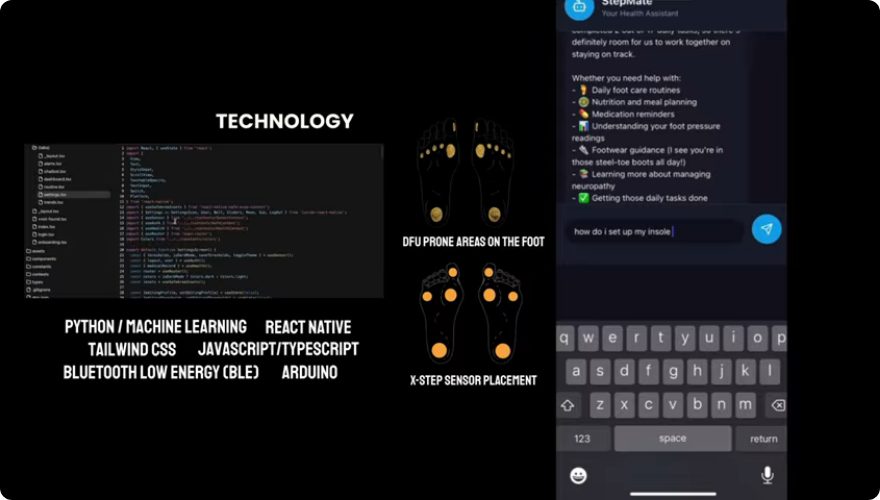
The problem is that diabetic foot ulcers form where pressure builds up unnoticed, often under a foot that has lost sensation. X-Step is the team's attempt at an inexpensive way to see that pressure: an insole worn in an ordinary shoe, an app that turns the readings into something a person can act on, and an assistant that answers care questions in plain language.
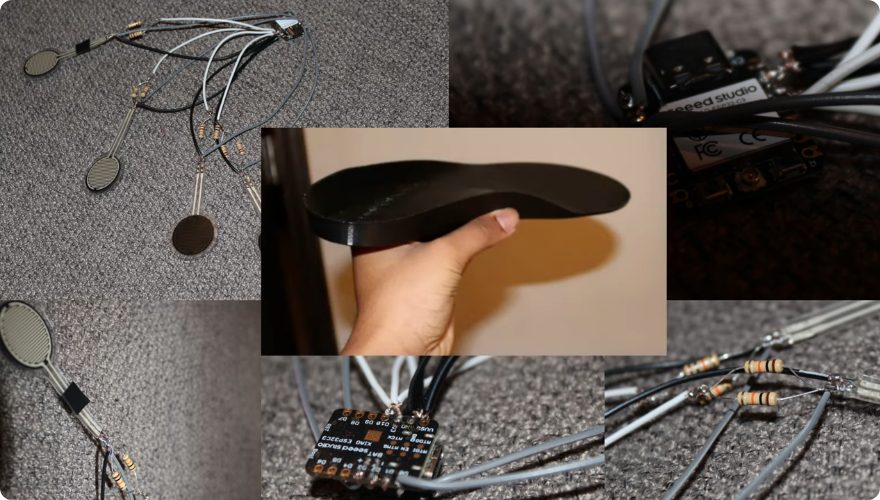
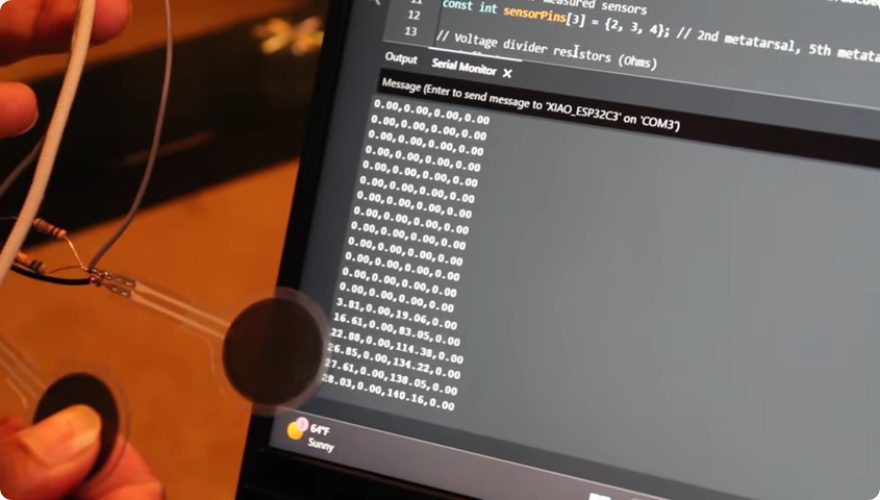
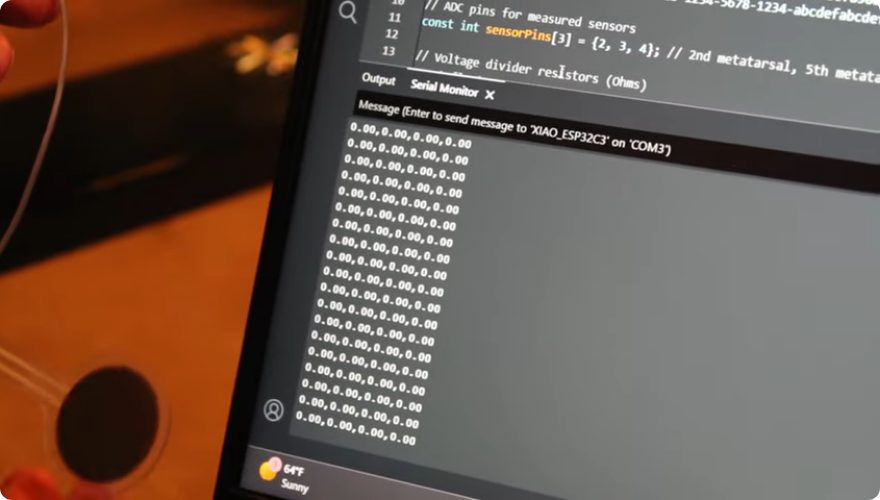
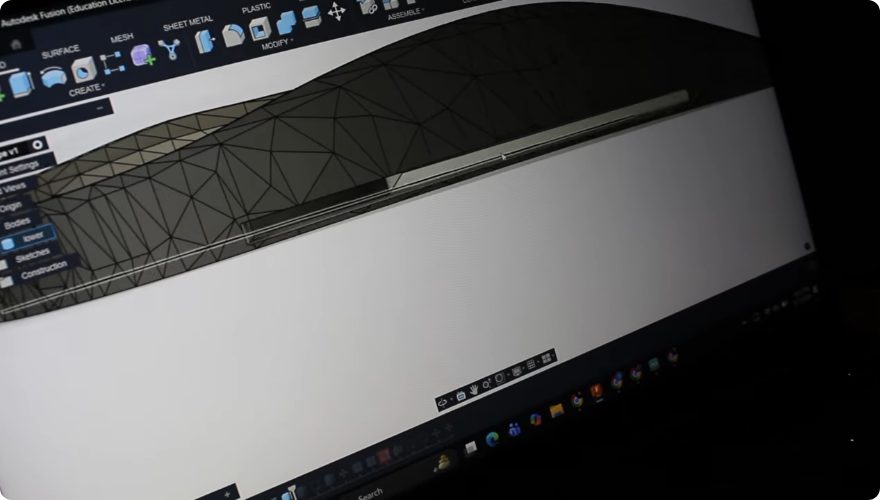
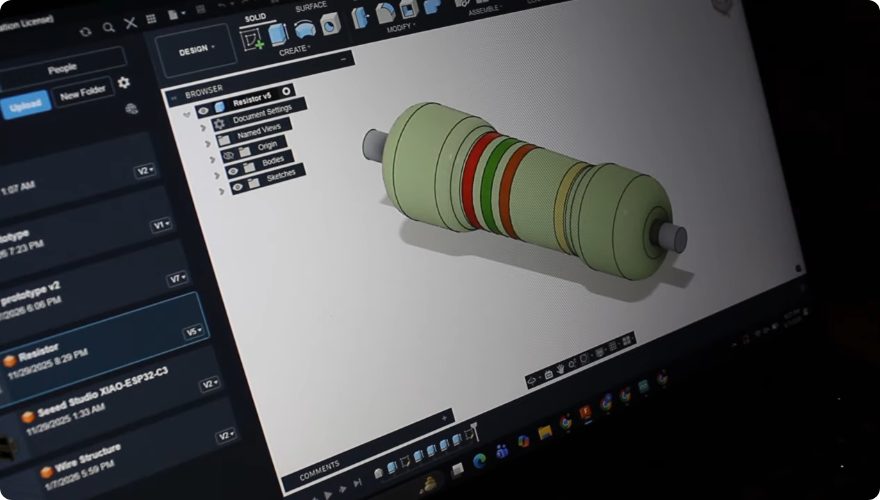
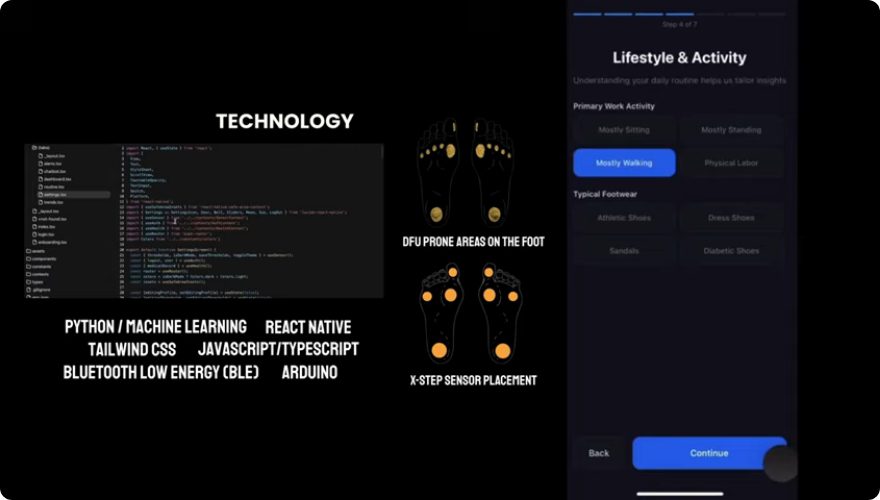
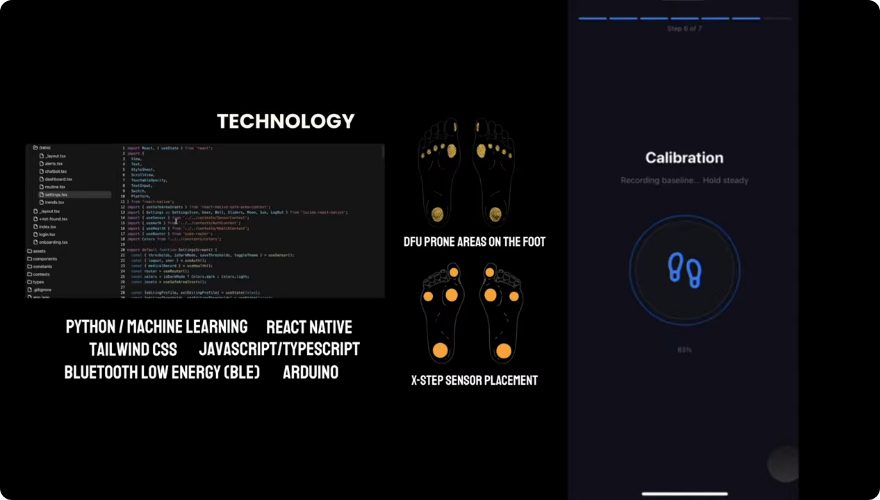
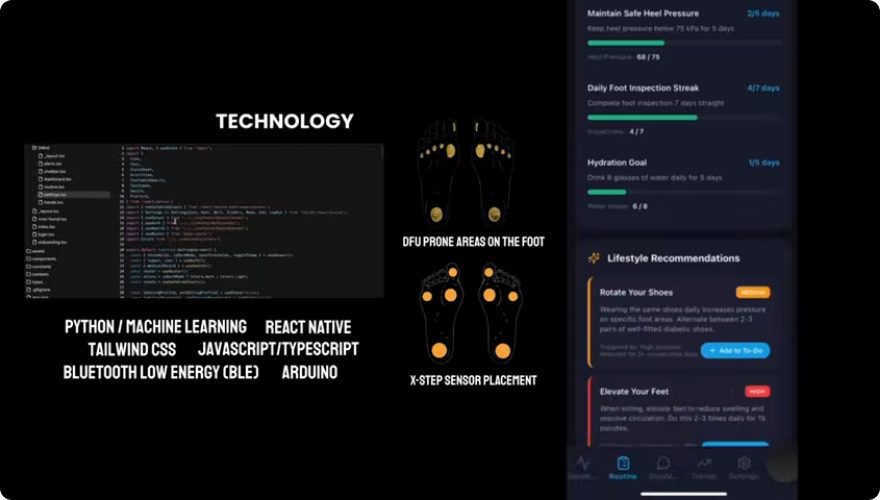
Frames from the team's Blue Ocean 2026 pitch video, posted on Arjun Subramanian's YouTube channel: Blue Ocean 2026 pitch video.
The app
The app is React Native with Expo. It connects to each insole over Bluetooth Low Energy, streams the four pressure channels into a live heatmap, and keeps a daily risk score, alerts, trends and a guided care routine. Onboarding collects the health context the score needs (diabetes type and duration, neuropathy, footwear and activity), and a short calibration records a resting baseline before walking. I wrote this app and the earlier Flask backend behind its health assistant.
The CNN prototypes
Two image models were trained as prototypes on public data. An EfficientNet-B2 classifies foot-pressure heatmaps into nine posture classes (98.3% on a random 80/20 split of a public dataset). A ResNet-50 grades wound photos into four severity levels. The team's design is that a photo's severity grade, together with a person's care habits, goes to a language model that drafts routines.
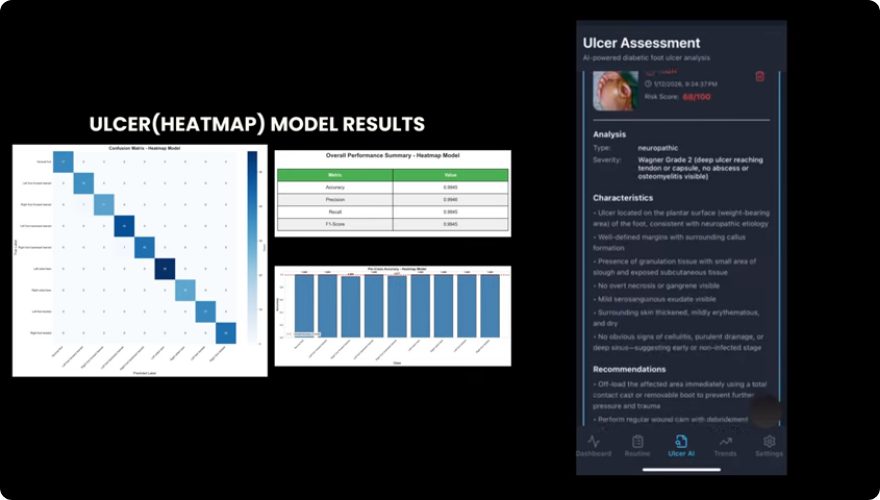
What is implemented and what is validated
- Implemented by the team: the insole hardware, firmware and Bluetooth frame format. Implemented by me: the app, the health-assistant backend, the feature pipeline and the two CNN prototypes.
- Not validated: no walking data from wearers of the insole exist yet, the CNN results come from public datasets rather than X-Step data, and the ulcer-photo-to-routine flow is a design shown in a demo. No clinical efficacy is claimed for any of it.
The pitches
The team presented X-Step in the Congressional App Challenge (video posted October 30, 2025) and in the 2026 Blue Ocean competition, where the pitch used strategy tools such as a red-ocean/blue-ocean value graph and an eliminate-reduce-raise-create grid. Only participation is stated here; neither is a placed result.
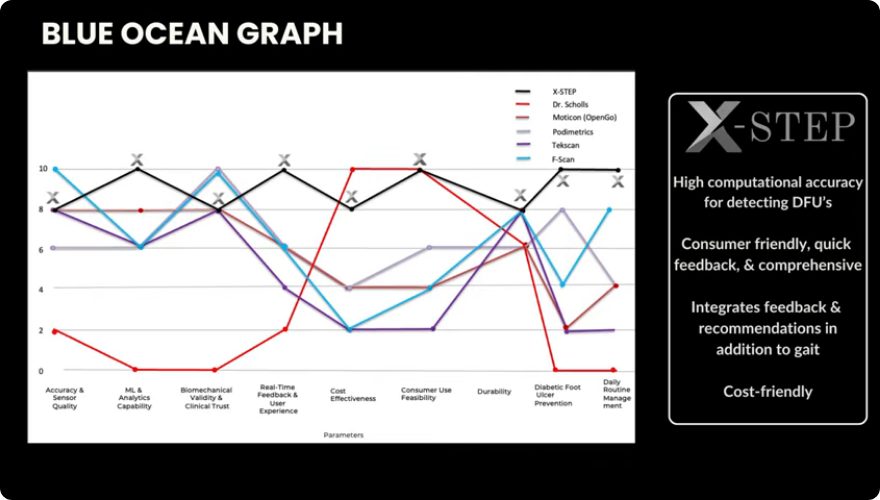
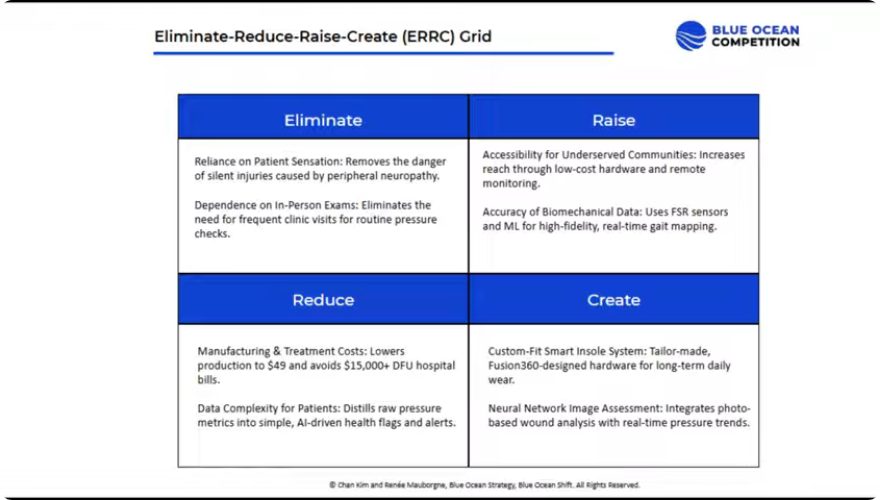
Videos: Congressional App Challenge presentation and Blue Ocean 2026 pitch video. Both are on Arjun Subramanian's YouTube channel; the frames above are screenshots from them.
Who did what
X-Step is a team project. The hardware, firmware and production inference code were largely written by my teammates. I built the machine-learning pipeline described below, the mobile app, and the early backend and CNN prototypes. The research paper on the insole is a separate piece of work from this product, described on the research page.
Status
X-Step is a working prototype. No walking data from X-Step wearers have been collected yet. A prospective study under ethics approval is the step between this prototype and any clinical use.
Recognition
These are team results for the X-Step product and pitch in entrepreneurship competitions. They are not awards for the research paper.
- Texas A&M McFerrin Center for Entrepreneurship Texas Ideas Challenge, 2026 Top 40 Finalist: official finalist list
- Diamond Challenge, 2026 semifinalist
- Conrad Innovator 2025–2026, Health & Nutrition